 Loire Valley Castles Tour
Château D'Amboise: A Visitor Guide to the Royal Castle
The Château d'Amboise is the royal castle above the Loire at Amboise, a favoured residence of the French kings from Louis XI to Francis I and the site of Leonardo da Vinci's presumed resting place. This guide covers the visit in walking order: the rampart terraces, the Saint-Hubert chapel, the royal lodge and the gardens. It also gives the opening hours month by month, the winter lunch break, how to get there from Paris or Tours, and what a visit costs compared with booking a guided day such as Loire Valley castle tours from Paris.
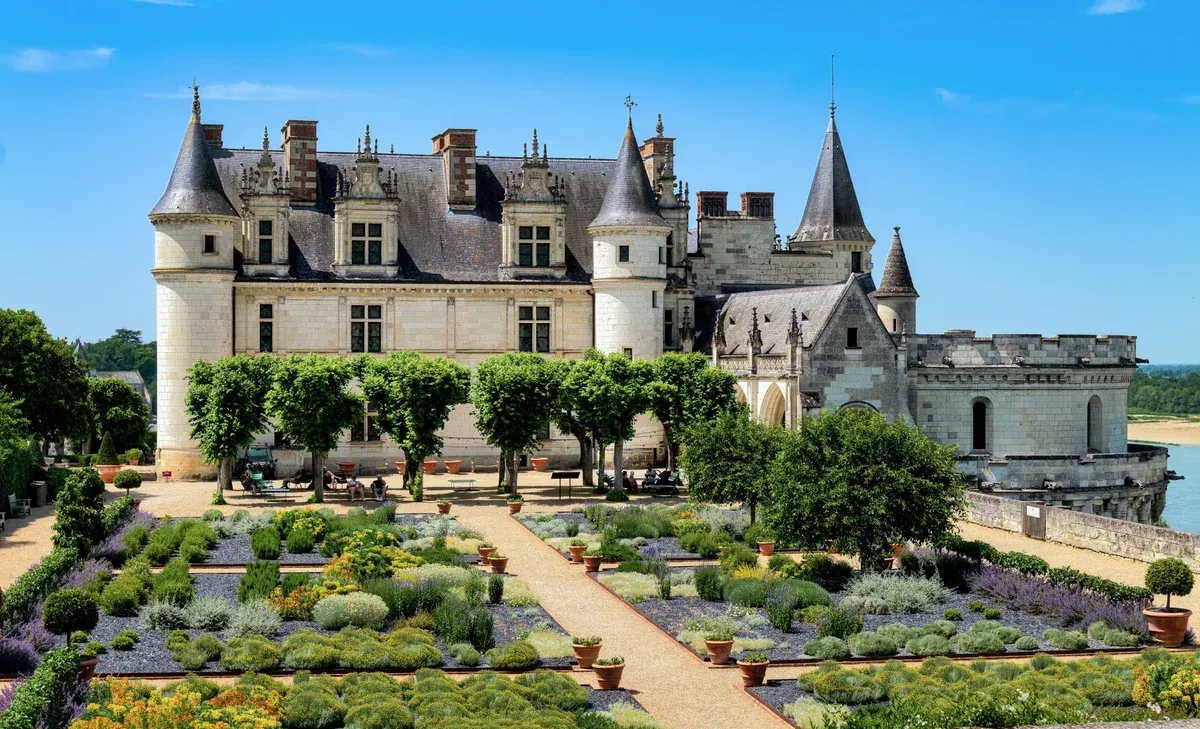
The Charles VIII wing of Château d'Amboise above its terraced garden beds. Photo: Rolf Kranz, CC BY-SA 4.0, via Wikimedia Commons
Quick answer The short answer
The Château d'Amboise opens at 9:00 for most of the year, with summer closing pushed back to 19:00 in July and August. The visit covers the royal lodge, the gardens and the Saint-Hubert chapel where Leonardo da Vinci is presumed to rest. The dated entry ticket is booked through the entry ticket further down this page, and the HistoPad tablet is included in admission.
Key takeaways
- Short on time? The small-group day trip from Paris covers Amboise, Chenonceau and Chambord in 12 hours at $280 per person.
- Already in the Loire? The day tour from Tours and Amboise visits Chenonceau and Chambord and leaves you 2.5 hours in Amboise.
- Check the opening hours by month and the winter lunch break before you set out, because the castle closes between 12:30 and 14:00 for several weeks in winter.
- Follow the visit in walking order to catch the rampart views, the chapel and the Charles VIII wing without backtracking.
Visiting the Château D'Amboise: Hours, Tickets and Time
The essentials first: when the castle opens, how long the visit takes and how to reach it.
Hours, Timing and Getting There
The figures below come from the château's own practical information pages and its hours and tariffs sheet. The ticket office closes 45 minutes before the domain closes. Visitors with reduced mobility are advised to arrive at least 1 hour before the ticket office closes. The castle is closed on 1 January and 25 December. The dated entry ticket is booked through the entry ticket further down this page, where the price table is added automatically.
For the rest of the town, the market and where to eat, see the guide to Amboise, and for Leonardo's house see Clos Lucé, 500 metres from the royal castle.
| What | Detail |
|---|---|
| February | 9:00 to 17:00 |
| March (to 26 March) | 9:00 to 17:30 |
| March (from 27 March) and April | 9:00 to 18:00 |
| May and June | 9:00 to 18:30 |
| July and August | 9:00 to 19:00 |
| September | 9:00 to 18:00 |
| 1 October to 1 November | 9:00 to 17:30 |
| Winter lunch break | 12:30 to 14:00 closure from 5 January to 6 February (open 10:00 to 16:30) and from 2 November to 18 December (open 9:00 to 17:00) |
| Closed days | 1 January and 25 December |
| How long to allow | Not stated by the château. The visit takes in a royal lodge over three levels, the chapel and the gardens |
| By train from Paris | About 1.5 hours, by regional train from Paris Austerlitz or TGV to Saint-Pierre-des-Corps, 20 km from Amboise |
| By car from Paris | About 2.5 hours via the A10, A28 and A85, per the Amboise tourist office |
| Parking | Four large car parks in Amboise are free |
| Ticket | Book the dated entry ticket through the entry ticket further down this page |
When to Go, Free Entry and the Seasons
Spring and early autumn give you long opening hours. From late March the castle stays open to 18:00 or later, and the rampart terraces over the Loire are at their best in the low evening light of the 19:00 summer closing. In midsummer, arrive at 9:00 or after 16:00. In winter, watch the lunch break: from early January to early February the site opens 10:00 to 12:30 and 14:00 to 16:30, and from early November to mid-December it closes between 12:30 and 14:00 while keeping 9:00 to 17:00 hours. The castle shuts completely on 1 January and 25 December.
The château belongs to the Fondation Saint-Louis and has been a listed monument since 1840. Dogs on a lead under 2 metres are welcome in the gardens but must be carried indoors, and only assistance dogs go everywhere. Pushchairs can be left in the unattended area on the Guards' Walk of the ground floor of the royal lodge. Job seekers get a reduction with proof. Combination tickets exist with Clos Lucé and with Chenonceau as a three-castle deal, and the Amboise City Pass covers the royal château along with Clos Lucé, Château Gaillard, the Chanteloup Pagoda and more, valid 1 April to 31 October.
What to See, in Visiting Order
The visit runs across three levels, from the Renaissance rooms to the chapel and the gardens above the river.
The Rampart Terraces and the View Over the Loire
The ramparts look west over the town and north and east over the Loire. Charles VII seized the stronghold on 4 September 1434, and from Louis XI to Francis I it was one of the favourite houses of the French crown. Charles VIII began rebuilding in 1492 and after 1495 brought Italian craftsmen to Amboise, including Domenico da Cortona and Fra Giocondo, so Italian influence arrived at Amboise early.
Give the terraces 15 minutes at arrival and again near closing.
The Tour Des Minimes
The visit takes in the Tour des Minimes and the guard rooms of the lodge. The HistoPad tablet is included in admission and comes in 12 languages including Japanese and Korean.
The Ground and First Floors of the Royal Lodge
The visit inside the lodge has three levels. The ground and first floors evoke the Renaissance and take in the guard rooms, the great Council room and the king's bedroom. In the Council room, portraits of Francis I hang among the sculpted decoration, and his emblem, the salamander, appears in the carved stone throughout.
Francis arrived at Amboise aged 7 with his mother and his sister, and the castle remained one of his favourite palaces. In the king's bedroom hangs a large painting of the death of Leonardo da Vinci, who arrived at Clos Lucé in 1516 and died there on 2 May 1519.
The Second Floor and the Louis-Philippe Years
The second floor changes century and tells the 19th-century story, when Louis-Philippe renewed the château. Confiscated after Louis-Philippe's abdication in 1848, Amboise was used to hold Emir Abd el-Kader, the Emir of Algeria, who was kept here from November 1848 until his release was announced in October 1852. Louis-Philippe's heirs recovered the castle in 1873, and a major repair campaign was directed by Viollet-le-Duc.
The Fondation Saint-Louis owns Amboise today.
The Saint-Hubert Chapel and the Tomb of Leonardo
Outside the lodge, the Saint-Hubert chapel stands on the rampart walk. The chapel dates from 1493 and is a former royal oratory with carved tuffeau decoration. Inside, a marble stone marks the presumed resting place of Leonardo da Vinci.
The history is honest about the doubt: Leonardo was first buried in the Chapel of Saint-Florentin, which was demolished after the Revolution, and bones excavated there in the 19th century are said to rest in Saint-Hubert, though their identity is disputed. Either way, this is the site the world treats as his grave, and Charles VIII himself died at Amboise in 1498 after striking his head on a door lintel, so the castle's history is written in its doorways as much as its chapels.
The Gardens and the Terrace of Naples
The gardens cover just over 2 hectares above the river. The Terrace of Naples here was the first Italian-style garden in the kingdom, laid out by Pacello da Mercogliano, the gardener Charles VIII brought from Italy and who also designed the gardens at Blois. Today the garden holds the Jardin Remarquable label and the LPO bird refuge label, with more than 90 bird species recorded, so binoculars earn their space.
Every lawn is open for picnics. One closure to note: the Oriental Garden is currently shut because of work on the southeastern rampart. Plan the garden for last, when the light drops over the Loire and the town turns golden below the walls.
Chateau Amboise with Leonardo Da Vinci Tomb, Loire Valley - France 4K
A visit to the royal castle at Amboise, including the chapel said to hold Leonardo da Vinci's tomb. Third-party video by Haswell Travelled. This site did not shoot it and has no relationship with the creator.
A Short History of the Château D'Amboise
The Château d'Amboise was a royal residence before it became a monument. Its story runs from a seizure in 1434 to a foundation that owns it today.
From Charles VII to Charles VIII
Charles VII seized Amboise on 4 September 1434, and from then on the castle was a favoured residence of the French kings from Louis XI to Francis I. Charles VIII began rebuilding it in 1492 and, after 1495, brought Italian craftsmen to the site, including Domenico da Cortona and Fra Giocondo. The gardener Pacello da Mercogliano, also brought from Italy, designed the gardens at Amboise and at Blois. The Saint-Hubert chapel dates from 1493.
Charles VIII did not enjoy his palace for long. He died at Amboise in 1498 after hitting his head on a door lintel.
Francis I and Leonardo
Francis I arrived at Amboise aged 7 with his mother and sister, and the château became one of his favourite palaces. His emblem, the salamander, appears in the sculpted decoration, and portraits of him hang in the large council room. Leonardo da Vinci lived nearby at Clos Lucé, which is covered in its own guide.
Leonardo died on 2 May 1519. He was first buried in the Chapel of St Florentin, which was demolished after the Revolution. Bones excavated there in the 19th century are said to rest in the Saint-Hubert chapel, though their identity is disputed, so the marble stone there marks his presumed resting place.
In 1560 the Amboise conspiracy was suppressed by a month of hangings, and Wikipedia records that 1,200 Protestants were hanged by the end.
Prison, Restoration and the Foundation
The state confiscated Amboise in 1848 after Louis-Philippe's abdication and used it to hold the Emir Abd el-Kader, who was kept there from November 1848 until his release was announced in October 1852. Louis-Philippe's heirs got the château back in 1873, and Viollet-le-Duc directed a major repair campaign. Amboise has been listed as a monument historique since 1840.
Today the Fondation Saint-Louis owns the château, and the second floor of the residence shows the 19th century rooms of the Louis-Philippe era alongside the Renaissance floors below.
Key Dates at a Glance
The table below lists only the years given in the sources, so you can place each chapter of the story before you visit.
| Year | What happened |
|---|---|
| 1434 | Charles VII seized Amboise on 4 September |
| 1492 | Charles VIII began rebuilding the château |
| 1493 | The Saint-Hubert chapel was built |
| 1498 | Charles VIII died after hitting his head on a door lintel |
| 1519 | Leonardo da Vinci died on 2 May |
| 1560 | The Amboise conspiracy was suppressed |
| 1840 | Amboise became a monument historique |
| 1848 | Confiscated after Louis-Philippe's abdication, Abd el-Kader held there |
| 1873 | Louis-Philippe's heirs got the château back and Viollet-le-Duc led repairs |
Sources: Château d'Amboise, Wikipedia
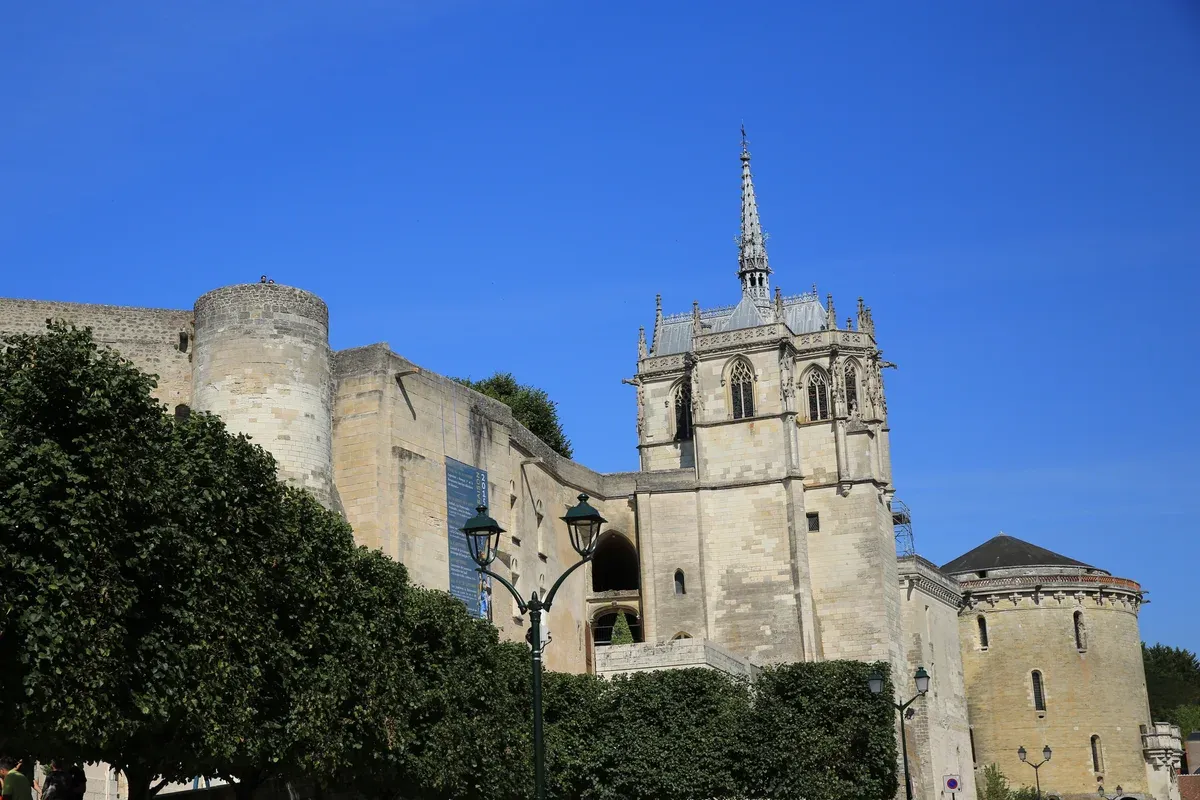
The ramparts and the Chapelle Saint-Hubert at Château d'Amboise under a blue sky. Photo: Als33120, CC BY-SA 4.0, via Wikimedia Commons
Getting There Without a Car, and With One
Amboise can be reached without driving, by train, bus or bike.
By Train
Amboise is about 1.5 hours from Paris by train. You can take a regional train from Paris Austerlitz, or a TGV to Saint-Pierre-des-Corps, which the château puts at about 20 km from Amboise. The Amboise regional train station also serves Tours and Orléans, so the château works well as a stop on a Tours-based trip.
A municipal bus links the station to the old centre if you do not want the walk.
By Bus, and by Bike
A regional bus links Amboise with Tours and Chenonceaux at least once a day, which makes a two-castle day possible on public transport. Regional trains also connect Amboise with Chenonceau and Chinon. Cyclists do well here too, because all Rémi trains allow bicycles on board, and the Amboise tourist office promotes cycling routes around the town.
If you plan a two-wheel day, the Loire Valley by bike guide covers routes and rental in detail.
By Car
Amboise is about 2.5 hours from Paris by road, per the Amboise tourist office, via the A10, A28 and A85. Three motorway exits serve the town: A10 exit 18 at Château-Renault 15 km north, A28 exit 20 at Tours 25 km west and A85 exit 11 at Bléré 15 km south. Amboise has four large car parks that are free.
Drivers should note two bridge rules: vehicles over 7.5 tonnes cannot cross the Pont Leclerc, and coaches must use the Pont Debré. Tours Val de Loire airport is 25 km away if you fly in.
Seeing the Château D'Amboise on a Tour
Not every Loire day trip from Paris enters the Château d'Amboise. Several tours in this comparison do, and they differ a lot in price, group size and what the ticket buys.
The Tours That Go Inside
The cheapest way to see Amboise on a guided day is the $280 small-group van tour, which caps the group at 8 and includes entrance tickets to Chenonceau, Chambord and Amboise, plus a wine tasting. Food and drinks apart from that tasting are not included. The tour with lunch in Amboise costs $376 per person and also runs in a van of 8 at most, but its listing does not name entrance tickets as included, so check with the operator before booking.
The private option costs $874 per person for 13 hours with hotel pickup and an art historian guide, and all fees and taxes are listed as included, though castle entrance tickets are not named separately.
| Tour | Price | Leaves from | Entry in price |
|---|---|---|---|
| Loire Valley Wine and Castles Small-Group Day Trip from Paris | $280 | Paris, 6 Avenue de Wagram | Yes, all three castles |
| Small-Group Loire Valley: Chambord, Chenonceau, lunch in Amboise | $376 | Paris, 78 Avenue de la Grande Armée | Not stated, ask the operator |
| Loire Valley Castles VIP Private Tour: Chambord, Chenonceaux, Amboise | $874 | Hotel pickup in Paris | All fees listed as included, tickets not named separately |
Comparing Them Honestly
If entry prices matter to you, the $280 small-group day is the only one of the three that names Amboise entrance tickets in the price. The $376 day buys you a sit-down lunch in Amboise. The $874 private day adds hotel pickup and an art historian guide in a private vehicle.
All three allow free cancellation 24 hours ahead. If you would rather build your own day from the town, the Amboise guide covers the town, its market and the station side of things.
Dos and Don'ts at the Château D'Amboise
Do
- Do ask for the HistoPad, because it is included in the admission fee and comes in 12 languages including Japanese and Korean.
- Do plan your arrival before the ticket office closes, since it shuts 45 minutes before the domain does, and visitors with reduced mobility are advised to come at least 1 hour before that.
- Do bring a picnic, because all the lawns in the château garden, which covers just over 2 hectares, are open for picnics.
- Do walk the ramparts, because they give views west over the town and north and east over the Loire.
- Do come in winter only with the lunch break in mind, because from early January to early February the château opens 10:00 to 12:30 and 14:00 to 16:30.
Don't
- Don't plan a visit on 1 January or 25 December, because those are the two days the château is closed.
- Don't let your dog off the lead, because dogs must be on a lead under 2 metres in the gardens and carried indoors, and only assistance dogs are allowed everywhere.
- Don't push a pushchair through the residence, because there is an unattended pushchair area on the Guards' Walk of the ground floor.
- Don't count on the Oriental Garden, because it is currently closed because of work on the southeastern rampart.
Book the Entry Ticket
A dated e-ticket is the one thing to sort before the day if you visit without a tour. The price is the lowest adult rate on the booking page, and free-entry rules still apply at the gate where the chateau offers them.
Ticket and Price
The table lists the entry ticket for this chateau with its starting price and the rating travellers gave it on the booking page. Prices change by date and option, so the final figure shows at checkout.
| Ticket | Price | Rating | Book |
|---|---|---|---|
| Château royal d'Amboise | from $19.38 | 4.7 from 2,249 reviews | Check Availability |
Château D'Amboise: Frequently Asked Questions
Is Leonardo da Vinci buried at the Château d'Amboise?
A marble stone in the Saint-Hubert chapel marks his presumed resting place. Leonardo died on 2 May 1519 and was first buried in the Chapel of St Florentin, demolished after the Revolution, and the bones moved to Saint-Hubert are of disputed identity. More on the chapel is in the visit section above, and Leonardo's house is covered in the Clos Lucé guide.
Did Leonardo da Vinci live in Amboise?
He lived at Clos Lucé, about 500 metres from the royal château, from 1516 until his death on 2 May 1519, but the château and its chapel hold his tomb. The two sites are easy to combine in one day, as the Amboise guide explains.
Where is Amboise in France?
Amboise sits on the Loire, 27 km east of Tours and about 1.5 hours from Paris by train. The nearest TGV station is Saint-Pierre-des-Corps, about 20 km away. How the journeys work is set out in Paris to the Loire Valley.
How much does it cost to visit the Château d'Amboise?
The dated entry ticket is booked through the entry ticket further down this page, where the current price table is added automatically. The HistoPad is included in the admission fee, and combination tickets with Clos Lucé and with Chenonceau exist.
How long do you need at the Château d'Amboise?
Not stated by the château as a fixed visit time, but the domain holds a royal residence over three floors, the Saint-Hubert chapel, gardens of just over 2 hectares and the rampart walk, and the ticket office closes 45 minutes before the domain. Comparing half-day and full-day options is covered by Loire Valley castle tours.
Can you visit the Château d'Amboise without a car?
Yes. The regional station serves Paris Austerlitz, Tours and Orléans, a municipal bus links the station to the old centre, and a regional bus links Amboise with Tours and Chenonceaux at least once a day. The train options are detailed in Paris to Loire Valley by train.