 Loire Valley Castles Tour
Château de Chambord: the Complete Visitor Guide
Château de Chambord is a Renaissance castle in the Loire Valley and this guide covers the visit in walking order. You get the opening hours, the ticket rules, the bus from Blois, the car parks and the park paths. It also explains the double-helix staircase, the closed François I wing and the estate of 5,440 hectares around the building. If you would rather see Chambord with transport sorted, the Loire Valley castle tours compared on this site include day trips from Paris and small-group days from Tours.
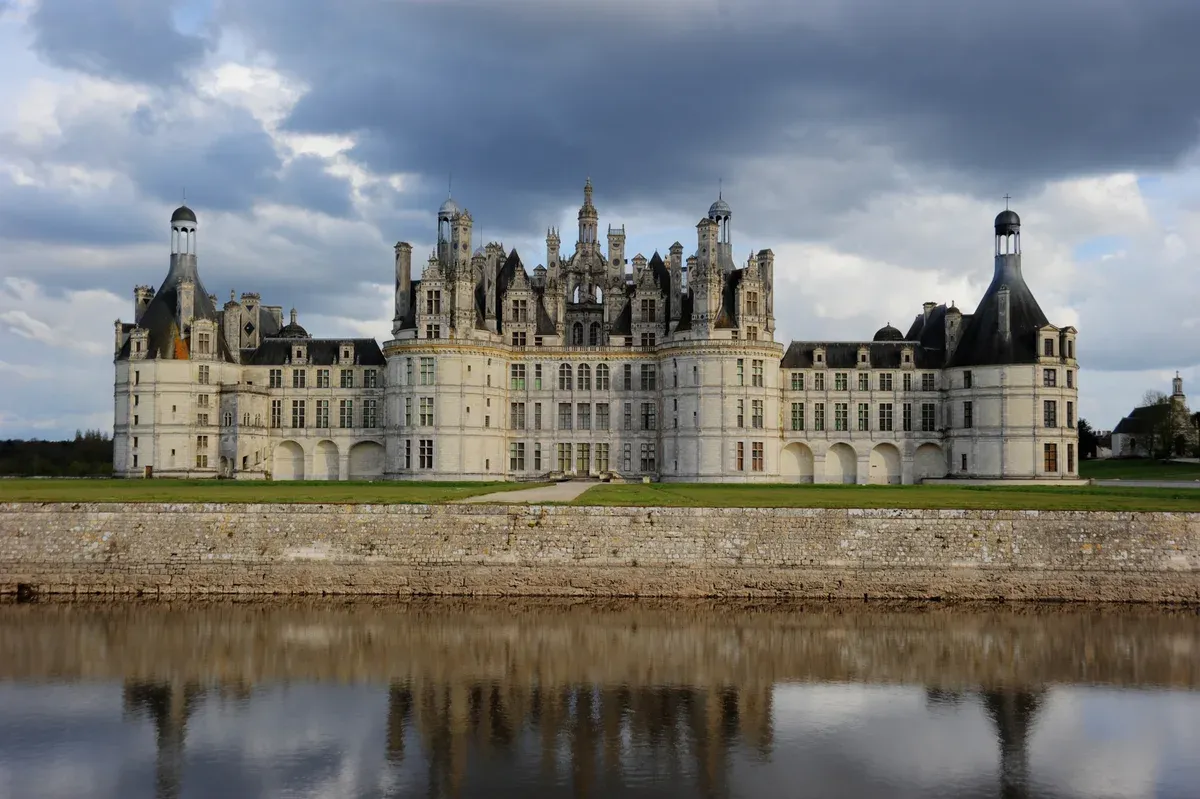
The south front of Château de Chambord reflected in the water, with its roofline of towers and chimneys. Photo: LaurentC92, CC BY-SA 3.0, via Wikimedia Commons
Quick answer Chambord in short
Château de Chambord opens 9:00 to 17:00 in low season and 9:00 to 18:00 in high season, and you should allow at least 1.5 hours for the essentials or about 4 hours with the gardens. The estate covers 5,440 hectares behind a 32 km wall. The dated entry ticket is booked through the entry ticket further down this page.
Key takeaways
- Getting there without a car: Rémi line 2 leaves Blois station at 9:20 and 12:20 and the ride takes about 35 minutes, see the hours and access section.
- Inside the castle the visit runs through the keep, the double-helix staircase and the vaulted second floor before the galleries and wings.
- Prefer a guided day with transport from Paris or Tours? Compare Loire Valley castle tours or go straight to the Chenonceau and Chambord day from Tours.
- A local option is the 1.5-hour guided visit of Chambord Castle in groups of 10 at most, sold without the castle ticket.
Visiting Chambord: Hours, Tickets and Time
The practical basics first: when the castle opens, how long the visit takes and how you reach a building that sits in the middle of the largest walled park in Europe.
Hours, Access and Tickets at a Glance
The figures below come from the Chambord estate, the Rémi bus network and the operators' own listings. Chambord runs two seasonal timetables and shuts completely on 1 January and 25 December. Low season also brings some Monday closures, so check the closing days before you travel. Tickets for the castle itself are handled separately from this guide, and the rules around free entry are set by the estate.
For the castle entry itself, the dated entry ticket is booked through the entry ticket further down the page, where the price table is added automatically. Entry is free for under 18s, for EU citizens aged 18 to 25 and for disabled visitors plus one companion.
| What | Detail |
|---|---|
| Opening hours, low season | 9:00 to 17:00 (4 January to 27 March and 26 October to 18 December) |
| Opening hours, high season | 9:00 to 18:00 (28 March to 25 October and 19 December to 2 January) |
| Closed | 1 January, 25 December, and some Mondays in low season: 5, 12, 19 and 26 January, 2 February, 9, 16 and 23 March |
| Time to allow | At least 1.5 hours for the essentials, about 4 hours for the château plus gardens |
| HistoPad tablet tour | Designed to take about 1.5 hours, 16 stations, twelve languages |
| By bus from Blois | Rémi line 2 from Blois station at 9:20 and 12:20, returns at 13:10 and 17:00, about 35 minutes each way |
| Bus fare | €3.40 single, €6.80 return per the Rémi site, and the ticket gives a discount on Chambord entry |
| Bikes on the bus | By reservation on 0 806 70 33 33, up to 8 bikes, booked by 17:00 the day before |
| By car | About 2 hours from Paris, 25 minutes from Blois, via A10 exits 16 or 17, A85 exit 13 or A71 exit 3 |
| By bike | More than 25 km of bike paths on the estate, free bike parking, certified Loire à Vélo and Accueil Vélo |
| Castle ticket | Booked through the entry ticket on this page, the price table is added there |
| Two-tier pricing | Described by the estate as experimental, introduced 14 January and valid through 31 December |
When to Go, Free Entry and What Changes by Season
High season runs from late March to late October and gives you an extra hour each day, with the castle open to 18:00. That is the window for the horse show, which runs at 11:45 on weekdays and at 11:45 and 16:00 at weekends, in holidays and in summer, with no show on Mondays. The evening festival brings eight concerts from 4 to 11 July, with doors at 19:30 and concerts at 20:30. In the forest, the stag rut runs from mid-September to mid-October and you can hear the bellowing from the paths. In autumn and winter the estate advises warm clothing.
Free entry is fixed by the estate: under 18s, EU citizens aged 18 to 25 and disabled visitors plus one companion pay nothing. Groups that qualify should still expect a security check at the entrance, the same as paying visitors. Low season has one trap: some Mondays in January, February and March are closed, listed in the table above. If you want to combine Chambord with other castles, the Blois tourist office sells more than 20 Pass'Châteaux packages of 3, 4 or 5 castles, including one that combines Blois, Chambord and Cheverny. Those passes exclude guided tours, audioguides and the HistoPad, and they are not recommended for children, students or seniors, who pay less buying individual tickets. The broader Loire Valley castles each have their own guide on this site, and if you would rather let a driver handle the distances, the Loire Castles Day Trip with Wine Tasting from Paris covers Chambord and Chenonceau in one day.
Sources: Château de Chambord, Château de Chenonceau, Blois-Chambord tourist office
What to See, in Visiting Order
A Chambord visit centres on the three floors of the keep, reached by the grand central staircase, then the galleries to the wings. Here is the route in the order you walk it.
The Cour D'honneur and the Keep
You enter through the court enclosure added around 1526, after François I returned from captivity in Madrid, when two lateral buildings were joined to the keep. The keep itself is a square building with four monumental corner towers, and its façade runs 128 metres at 56 metres high. Inside, four vestibules form an equal-armed Greek cross with the staircase at the centre.
The cross-shaped vestibule rooms measure 9 metres wide and 18 metres long. The architect is unknown, because the building-site records were dispersed or destroyed at the end of the 18th century, though the estate credits Leonardo da Vinci's influence on the centre-plan design after François I invited him to France in 1516.
The Double-Helix Staircase
The central double-helix staircase is the reason many people come at all. Two spiral flights wind around a shared central axis, so two people can go up and down at the same time without ever meeting. The estate attributes the design to Leonardo da Vinci, whom François I invited to France in 1516 as 'premier painter, architect and engineer of the king'.
You reach it from the crossing of the four vestibules on every floor of the keep. Go up once for the pleasure of the geometry.
The Second-Floor Vaults
On the second floor of the keep, the cross-shaped room carries lowered vaults carved with François I's emblem, the salamander, along with the letter F and knotted ropes. Look up as you walk: these carved vaults are not decoration alone. They carry the paved terraces above and they include a rainwater drainage system, another element the official site links to Leonardo da Vinci's influence.
It also leads onto the roof terraces, where the estate counts 282 chimneys, with views over the 5,440-hectare estate.
The Roof Terraces
The terraces run above the second-floor vaults and give you a skyline of chimneys, gables and lantern towers with the forest beyond. The estate counts 282 chimneys on the building, which gives some sense of the scale up here. From the terraces you look down on the court enclosure, the French formal gardens replanted in 2017 and the tree line of the park wall.
The estate advises warm clothing in autumn and winter.
The François I Wing
The royal wing to the east is one of the two wings that break from the standard keep layout, the other being the chapel wing to the west. The François I wing was built between 1539 and 1545 and holds the king's private apartments and the council chamber. Plan your expectations before you go: nearly the whole wing has been closed to the public since 2023 for restoration, and the estate expects visitors to see it again by 2032.
The estate currently lists the lapidarium, the carriage room, the king's room and his study among the exceptionally closed rooms. Guided days from Tours flag this too, including the Chenonceau and Chambord day from Tours, whose listing warns that the wing is closed.
The Chapel Wing and the Film Room
The chapel wing to the west is the other wing that differs from the standard keep layout. Down on the ground floor of the castle, a room shows a 20-minute film on the architecture and history of Chambord, subtitled in five languages, and it is a good first stop if you arrive knowing little about the building. The castle has more than 60 rooms open to the public and a collection of 4,500 art objects, so the film helps you sort the essential rooms from the rest.
There is also a ramp to the ground floor of the keep, and the ground floor itself is accessible to wheelchair users, as are the formal gardens.
The French Formal Gardens
The formal gardens on the east side were replanted in 2017 on an 18th-century design. The reference is a drawing of 1734 showing a French-style garden of 6.5 hectares, and the replanting follows that design. They are included in the roughly 4 hours the estate suggests for the château plus gardens.
Wheelchair users can access the gardens, and the Café d'Orléans sits inside the château if you want a break nearby. From the gardens you can continue straight into the park, where a 4 km canal loop is open all year to walkers and cyclists.
The Park and Forest Paths
The estate covers 5,440 hectares, which makes it Europe's largest walled park, ringed by a 32 km wall. More than 20 km of newly created park paths open from May, on top of the 4 km canal loop open all year. Cyclists get more than 25 km of bike paths and free bike parking, and the estate is certified for Loire à Vélo and Accueil Vélo.
Electric carts can be rented on site, though they are not allowed in the formal gardens. In late summer the forest becomes the point of the visit in its own right: from mid-September to mid-October the stag rut fills the park with bellowing, and the paths put you close enough to hear it.
Inside Château de Chambord: France's Most SPECTACULAR Renaissance Castle
A walk inside Chambord, from the double-helix staircase to the roof terraces. Third-party video by Saving Castles. This site did not shoot it and has no relationship with the creator.
A Short History of Chambord
Chambord was a hunting lodge that grew into a château of 426 rooms by the estate's count, built for a king who barely lived in it. The dates below come from the estate's own history pages.
François I and the Unknown Architect
Work began in 1519 under François I, who wanted a royal hunting lodge. The name of the architect is unknown because the building-site records were dispersed or destroyed at the end of the 18th century. The estate credits Leonardo da Vinci with a strong influence on the centre-plan keep, the double-helix staircase and the rainwater drainage system. François I had invited Leonardo to France in 1516 as premier painter, architect and engineer of the king.
The scale got out of hand for a hunting lodge. The château ended up with 426 rooms, 282 chimneys and 77 staircases according to the estate, though Wikipedia puts it at 440 rooms, 282 fireplaces and 84 staircases. Around 1526, after François I returned from captivity in Madrid, two lateral buildings and the court enclosure were added around the keep. The François I wing, built between 1539 and 1545, holds the king's private apartments and the council chamber.
François I hardly enjoyed his palace. Wikipedia says he spent about seven weeks there in total, the estate says about fifty days. Both figures tell the same story.
Kings, Exiles and a Marshal
Louis XIV completed the building work and stayed at Chambord nine times between 1660 and 1685. On 14 October 1670 the court saw the world premiere of Molière's Le Bourgeois gentilhomme in the château. The theatre connection still shows up in the estate's programme, with an evening festival of eight concerts running from 4 to 11 July.
After the Bourbons, Chambord passed through a string of owners. Stanislas Leszczynski, the exiled king of Poland, lived there from 1725 to 1733. Maurice de Saxe received the château from Louis XV after his victory at Fontenoy in 1745 and died there in 1750. Napoleon gave it to Marshal Berthier in 1809. In 1821 a national subscription bought the estate for the Duke of Bordeaux, who styled himself Count of Chambord and wrote his White Flag Manifesto there during his only stay in 1871.
The 20th century brought war and rescue. During World War II the château stored artworks evacuated from the Louvre, including the Mona Lisa. On 22 June 1944 a US B-24 bomber crashed on the lawn. The French state has owned Chambord since 1930, and after 1930 it demolished the Louis XIV attics on the lower enclosure to bring back the Renaissance look.
Key Dates at a Glance
The table pulls the years named in the estate's history pages into one line each. Use it to place Chambord against the other Loire castles covered on Loire Valley castles.
| Year | What happened |
|---|---|
| 1516 | François I invites Leonardo da Vinci to France |
| 1519 | Construction begins as a royal hunting lodge |
| 1526 | Two lateral buildings and the court enclosure added |
| 1539-1545 | The François I wing is built |
| 1670 | Molière's Le Bourgeois gentilhomme premieres at Chambord |
| 1725-1733 | Stanislas Leszczynski, exiled king of Poland, lives at Chambord |
| 1745 | Maurice de Saxe receives Chambord after Fontenoy |
| 1809 | Napoleon gives Chambord to Marshal Berthier |
| 1821 | National subscription buys Chambord for the Count of Chambord |
| 1840 | Chambord joins France's first list of historic monuments |
| 1871 | The Count of Chambord writes his White Flag Manifesto there |
| 1930 | Chambord becomes property of the French state |
| 1944 | A US B-24 bomber crashes on the lawn |
| 1981 | Chambord is inscribed by UNESCO, before the wider Loire Valley listing in 2000 |
| 2017 | The French formal gardens are replanted on an 18th-century design |
The Closed François I Wing
One part of history you will not see is the king's own wing. Nearly the whole François I wing has been closed to the public since 2023 for restoration, and the estate expects visitors to see it again by 2032. The lapidarium, the carriage room, the king's room and his study are also listed among the rooms currently closed.
The Chenonceau and Chambord day tour from Tours flags this closure on its listing, which is honest of the operator. Plan the rest of the visit around it: the keep, the double-helix staircase, the roof terraces and the gardens are all open.
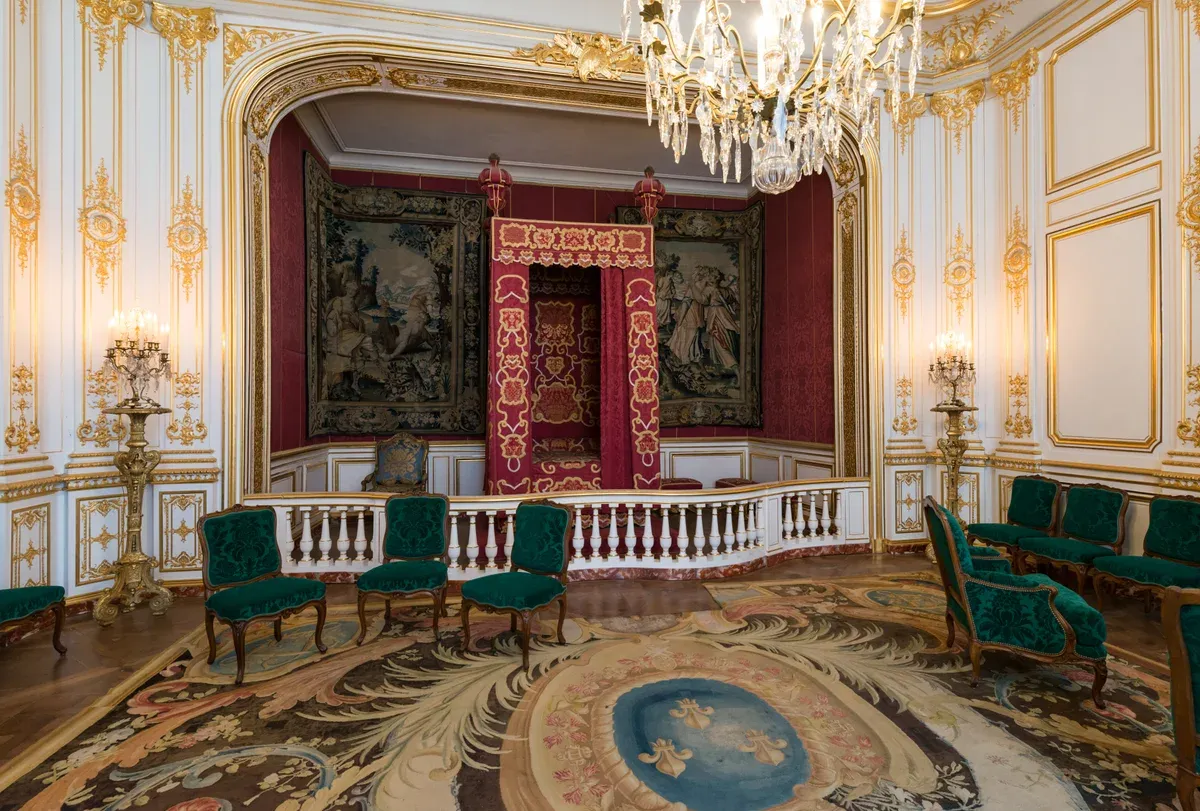
The gilded King's Chamber at Chambord with its canopied bed behind a balustrade. Photo: DXR, CC BY-SA 4.0, via Wikimedia Commons
Getting There Without a Car, and With One
Chambord sits in open farmland between Blois and Orléans, so the last stretch always needs a bus, a bike or a car. Here is what the estate and the Rémi network actually offer.
By Train and Bus from Blois
The nearest station is Blois-Chambord station in Blois, which is about 1h30 from Paris Austerlitz by train according to the Blois-Chambord tourist office, or 1h40 by the Cheverny site's count. From Blois station, Rémi line 2 runs year-round to Chambord and takes about 35 minutes. Buses leave Blois at 9:20 and 12:20 and return from Chambord at 13:10 and 17:00.
The fare is listed as €3.40 single and €6.80 return on the Rémi site, while chambord.org gives €3.30 and €6.60. Expect a few cents either way. A Rémi bus ticket also earns a discount on Chambord entry, which the estate does not price on the pages read for this guide. Two buses a day each way means a short day, and the 17:00 return bus is the one you cannot miss.
The estate also lists longer-distance options without a car: a Blablacar Bus from Paris Bercy running Thursday to Sunday in July and August, and a PARISCityVISION coach from Paris. The estate quotes 80 minutes from Paris by train, which gets you to the region but still needs the last leg.
By Car
Chambord is about 2 hours from Paris by car and about 25 minutes from Blois. From the motorway network you take the A10 at exit 16 or 17, the A85 at exit 13 or the A71 at exit 3. The estate has car parks. It also runs two picnic kiosks near the car parks if you bring lunch.
Driving gives you the freedom the timetable does not: the horse show at 11:45 on weekdays, or the 16:00 weekend slot, fits much more easily with your own wheels. If you would rather hand the road over to someone, the guided visits and day trips on the Loire Valley castle tours homepage cover the transport.
By Bike
Chambord is certified for the Loire à Vélo route and for Accueil Vélo, with more than 25 km of bike paths inside the estate and free bike parking. The estate's 32 km wall encloses 5,440 hectares, listed as Europe's largest walled park, and more than 20 km of new park paths open from May alongside a 4 km canal loop that is open all year to walkers and cyclists.
If you arrive by Rémi bus, bikes travel on board by reservation on 0 806 70 33 33, up to 8 bikes, booked by 17:00 the day before. All Rémi trains also allow bicycles. Blois, Chambord, Cheverny and Chaumont-sur-Loire all sit within 20 km of each other, so a bike day linking two of them is a normal move, and the Blois-Chambord tourist offices hand out a free map of the numbered loops. The full Loire Valley bike tour guide covers the wider route network.
Which Way Should You Come
The table lines up the four realistic ways to reach the gate, with times and fares from the estate and the Rémi network. The walking or driving distance from Blois-Chambord station to the château is not stated, but the 35-minute bus ride covers it.
| Way in | From | Time or fare |
|---|---|---|
| Rémi line 2 bus | Blois-Chambord station | About 35 minutes, €3.40 single (Rémi site, chambord.org says €3.30) |
| Train | Paris Austerlitz to Blois | About 1h30 to 1h40 |
| Car | Paris | About 2 hours via A10 exit 16 or 17, A85 exit 13 or A71 exit 3 |
| Car | Blois | About 25 minutes |
| Blablacar Bus | Paris Bercy | Thursday to Sunday in July and August |
| Bike | Inside the estate | More than 25 km of paths, free bike parking |
Seeing Chambord on a Tour
Ten of the bookable tours on this site put Chambord on the itinerary, from Paris, from Tours and from Amboise, plus one guided visit that starts at the castle gate. Entry is in the price for most of them, and this section says exactly which.
Day Trips from Paris That Enter Chambord
Six Paris departures visit Chambord. The cheapest is the full-day chateaux tour from Paris at $101 per person, a 13-hour coach day that also covers Chenonceau and Cheverny, with entrance tickets included, though the licensed guide and audio guide only come with a chosen option, and lunch is not included. On summer Mondays and Saturdays the listing swaps Chambord for Amboise. The day trip with wine tasting costs $115 per person over 12.5-13 hours and adds skip-the-line entry at Chambord and Chenonceau and a wine tasting in the Chenonceau cellar.
The small-group options raise the price and drop the group size. The small-group day from Paris is $280 per person for 12 hours in a van of up to 8, with entry to Chambord, Chenonceau and Amboise included. The small-group tour with lunch in Amboise is $376 per person and lists a sit-down lunch, but its listing does not say whether castle entry is included, so check with the operator before booking. The tour with entry tickets at $237 per person includes tickets and gardens at all three castles and hotel pickup. The private VIP tour is $874 per person with hotel pickup and an art historian guide, and it lists all fees and taxes as included without naming castle entrance tickets separately.
Day Trips from Tours and Amboise
Base yourself in Touraine and the day shrinks to around 8 to 9 hours. From Tours, the Chenonceau and Chambord day is $240 per person for 8 hours with tickets and guided visits at both castles included, and it is the listing that openly warns about the closed François I wing. The Tours and Amboise day trip is $231 per person for 9 hours with entry and guided tours at both castles, plus 2.5 hours of free time in Amboise.
From Amboise, the tour with lunch at a chateau is $268 per person for 8.5 hours, with entrance fees to Chenonceau and Chambord included and lunch at Chateau de Villesavin. All three run in vans of 8 at most.
A Guided Visit at the Castle Itself
If you arrive under your own steam by Rémi bus, car or bike, the guided visit of Chambord Castle is $50 per person for 1.5 hours in a group of 10 at most, with headphones included. Be clear on what the price covers: the castle admission ticket is not included, and you buy it yourself. The meeting point is in front of the castle entrance at 3 Av. du Roi, 10 minutes before the start, just before the security check.
It rates 4.9 from 94 reviews, level with the highest score among the Chambord options here.
Chambord Tours Compared
The table compares every tour on this site that enters Chambord, with the price per person as listed on each card, the departure city and whether castle entry is in the price. Full details sit on each tour page.
| Tour | Price | Leaves from | Entry in price |
|---|---|---|---|
| Full-Day Loire Valley Chateaux Tour | $101 | Paris | Yes, guide and audio guide only with the option |
| Day Trip With Wine Tasting | $115 | Paris | Yes, skip-the-line |
| Small-Group Day Trip from Paris | $280 | Paris | Yes |
| Small-Group with Lunch in Amboise | $376 | Paris | Not stated, check with the operator |
| 3 Castles Tour with Entry Tickets | $237 | Paris | Yes, castles and gardens |
| VIP Private Tour | $874 | Paris | Fees and taxes included, tickets not named separately |
| Chenonceau & Chambord Day Trip | $231 | Tours | Yes, with guided tour |
| Day Tour to Chenonceau and Chambord | $240 | Tours | Yes, with guided visit |
| Chambord and Chenonceau with Lunch | $268 | Amboise | Yes |
| Guided Visit of Chambord | $50 | Chambord | No, castle ticket bought separately |
Dos and Don'ts at Chambord
Nine rules that come straight from the estate's practical pages and the tour listings, each with the reason attached.
Do
- Do allow four hours if you want the château and the gardens, because the estate itself says an hour and a half covers only the essentials.
- Do catch the horse show at 11:45 on a weekday, or 11:45 and 16:00 at weekends and in holidays, because there is no show on Mondays.
- Do listen for the stag rut from mid-September to mid-October, because the bellowing carries across the forest of the 5,440-hectare estate.
- Do keep the 13:10 or 17:00 Rémi bus time in mind if you come from Blois, because those are the only two returns of the day.
- Do use the free lockers at the entrance for bags over 55 x 35 x 20 cm, because the estate requires larger items to be stored after the security check.
Don't
- Don't bring your dog into the château enclosure, the French gardens or the stables, because dogs are only allowed on a leash in the park itself.
- Don't pack a power bank for the visit, because they are not allowed inside the château or in its lockers.
- Don't come in January, February or early March without checking the calendar, because the château closes on 1 January and on some Mondays in low season.
- Don't plan a visit for the king's apartments, because nearly the whole François I wing has been closed for restoration since 2023 and is not expected to reopen before 2032.
Book the Entry Ticket
A dated e-ticket is the one thing to sort before the day if you visit without a tour. The price is the lowest adult rate on the booking page, and free-entry rules still apply at the gate where the chateau offers them.
Ticket and Price
The table lists the entry ticket for this chateau with its starting price and the rating travellers gave it on the booking page. Prices change by date and option, so the final figure shows at checkout.
| Ticket | Price | Rating | Book |
|---|---|---|---|
| Château de Chambord | from $24 | 4.7 from 2,264 reviews | Check Availability |
Château de Chambord: Frequently Asked Questions
Why is the Château de Chambord famous?
It is a Renaissance château with 426 rooms by the estate's count, 282 chimneys and 77 staircases, and a central double-helix staircase attributed to Leonardo da Vinci that lets two people pass without meeting. Its setting inside a 32 km wall around 5,440 hectares makes it Europe's largest walled park. The history is on the history section of this page.
Is Château de Chambord worth a visit?
Yes if you give it time. The estate asks for at least an hour and a half for the essentials and about four hours for the château plus the gardens, and there are more than 60 rooms open, roof terraces, a 20-minute film on the architecture and more than 25 km of bike paths. The visit tips are in the dos and don'ts above.
Who owns the Château de Chambord?
The French state has owned Chambord since 1930, after the estate passed from François I through Louis XIV, Stanislas Leszczynski, Maurice de Saxe, Marshal Berthier and the Count of Chambord. The full ownership chain is tabled in the history of Chambord.
How do I get to Chambord from Blois without a car?
Take Rémi line 2 from Blois station, which runs year-round, takes about 35 minutes and costs €3.40 single or €6.80 return on the Rémi site, with departures at 9:20 and 12:20 and returns at 13:10 and 17:00. A bus ticket also gives a discount on entry. The details sit in the getting there section.
How long should I allow inside Chambord?
The estate says allow at least an hour and a half for the essentials and about four hours for the château plus the gardens. The HistoPad tablet tour is designed for about an hour and a half on its own, across 16 stations from the ground floor to the second floor. Timings and opening hours are covered in the visiting section at the top of this page.
Can I visit Chambord on a day trip from Paris?
Yes. Several coach and minivan day trips run 12 to 13 hours return from Paris and enter the castle, starting at $101 per person, and most include the entry ticket in the price. The full comparison with prices and departure points is in the tours section of this page.